MERCH FOR MUTUAL AID
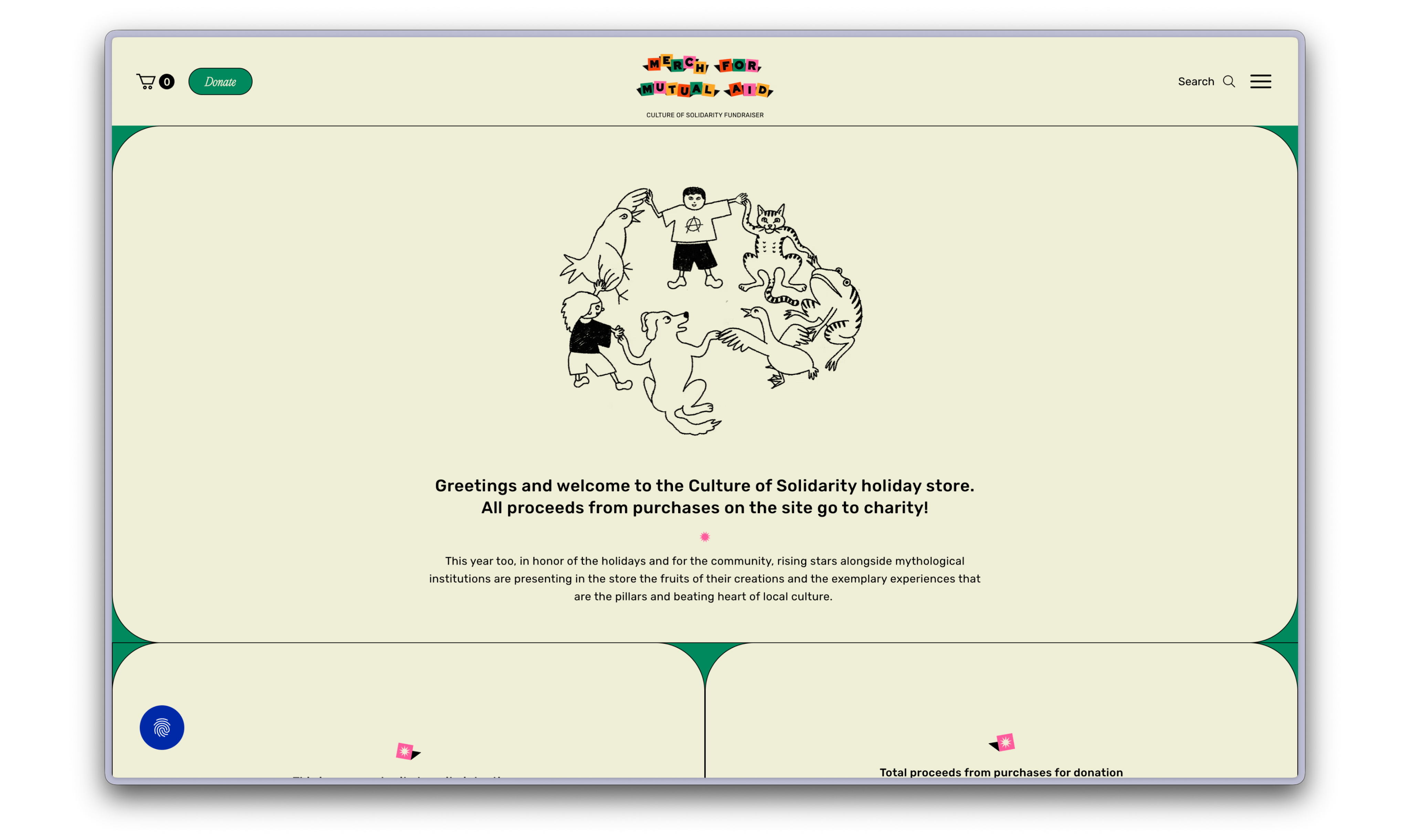
medium
Online Store & Digital Fundraiser
role
Creative Director, Product Manager, Executive Producer
overview
Since its early days, I have been an organizer with Culture of Solidarity, a volunteer-based grassroots movement operating on shared community resources rather than institutional funding. This online holiday gift store is the organization's largest annual fundraising initiative, which I led throughout its evolution, and this year for its second edition during active war. It transforms collective resources into direct action, building consensus around the dignity of all lives while funding food security operations across Israel and Palestine.
THE PROJECT
I led the project from end to end, collaborating this year alongside Omer Kishoni and designated team leaders. We launched as a week-long pop-up store during the December holidays, culminating in a physical closing event. In a climate of dehumanization and escalating violence, our audience was largely Israeli and Jewish diaspora, a public saturated with trauma and survivalist political campaigns. Our goal was to offer accessible activism, raise funds, and normalize a humane consensus. To be as inclusive as possible across ages and economic realities, we offered 238 unique items donated by 142 creators and businesses from local communities to cities like New York. The inventory ranged from physical goods and digital services to memberships and one-off experiences: tattoos, haircuts, books, private classes, theater tickets, and bakery memberships. In total, we raised 104,500 ILS, which was sufficient to run our food security programs for four months. Achieving this required directing specialized teams across web development, donor recruitment, design, marketing, and logistics.
THE CHALLENGE
Fulfilling this mission presented a twofold challenge. The rhetorical challenge required operating like a high-level campaign to build partnerships and craft a meticulous, unifying aesthetic. The logistical challenge demanded an infrastructure capable of managing highly fragmented data. We needed a system that made donating and fulfillment effortless for everyone involved: the contributing businesses, the buyers, and the volunteer teams operating behind the scenes.
CURATION & DESIGN
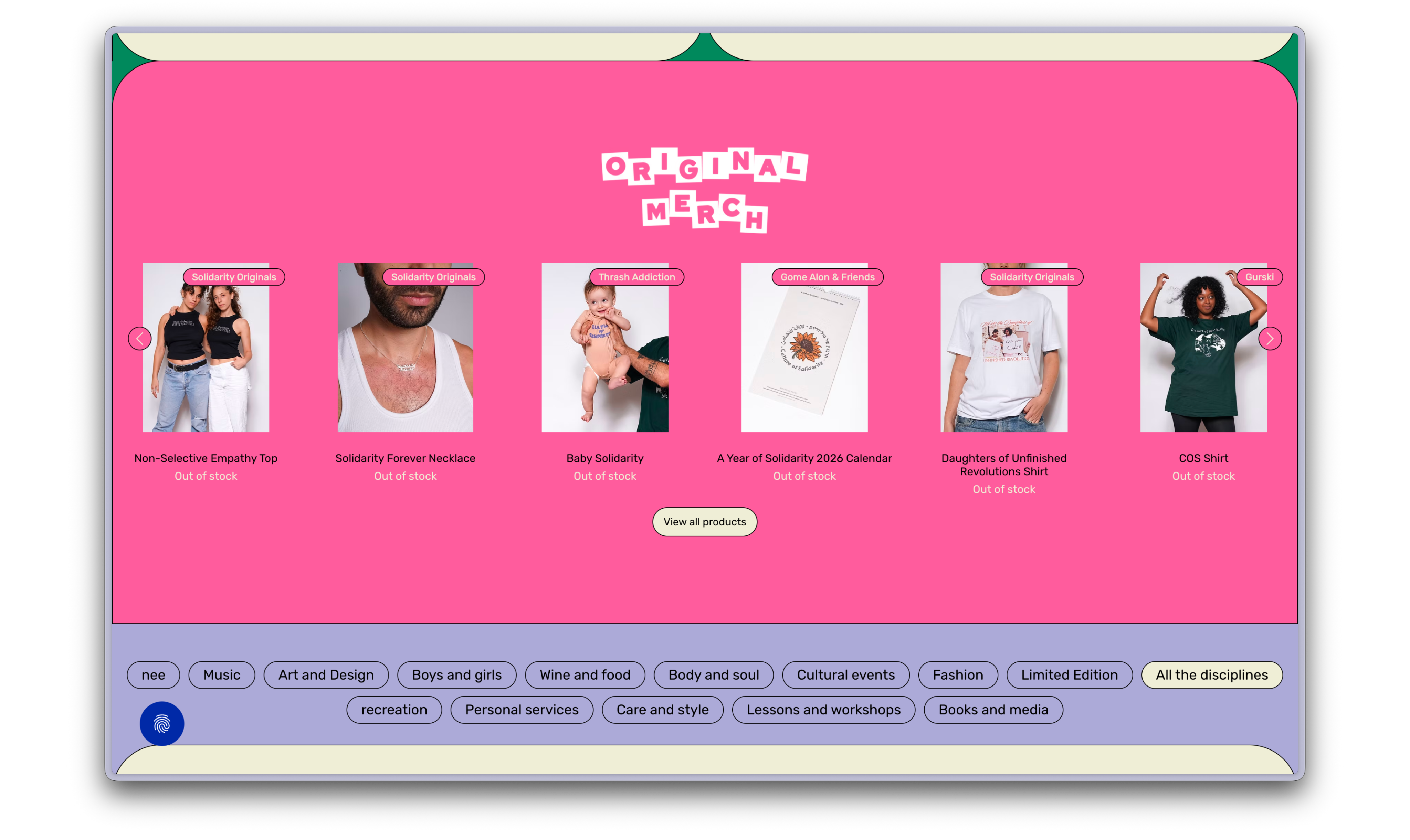
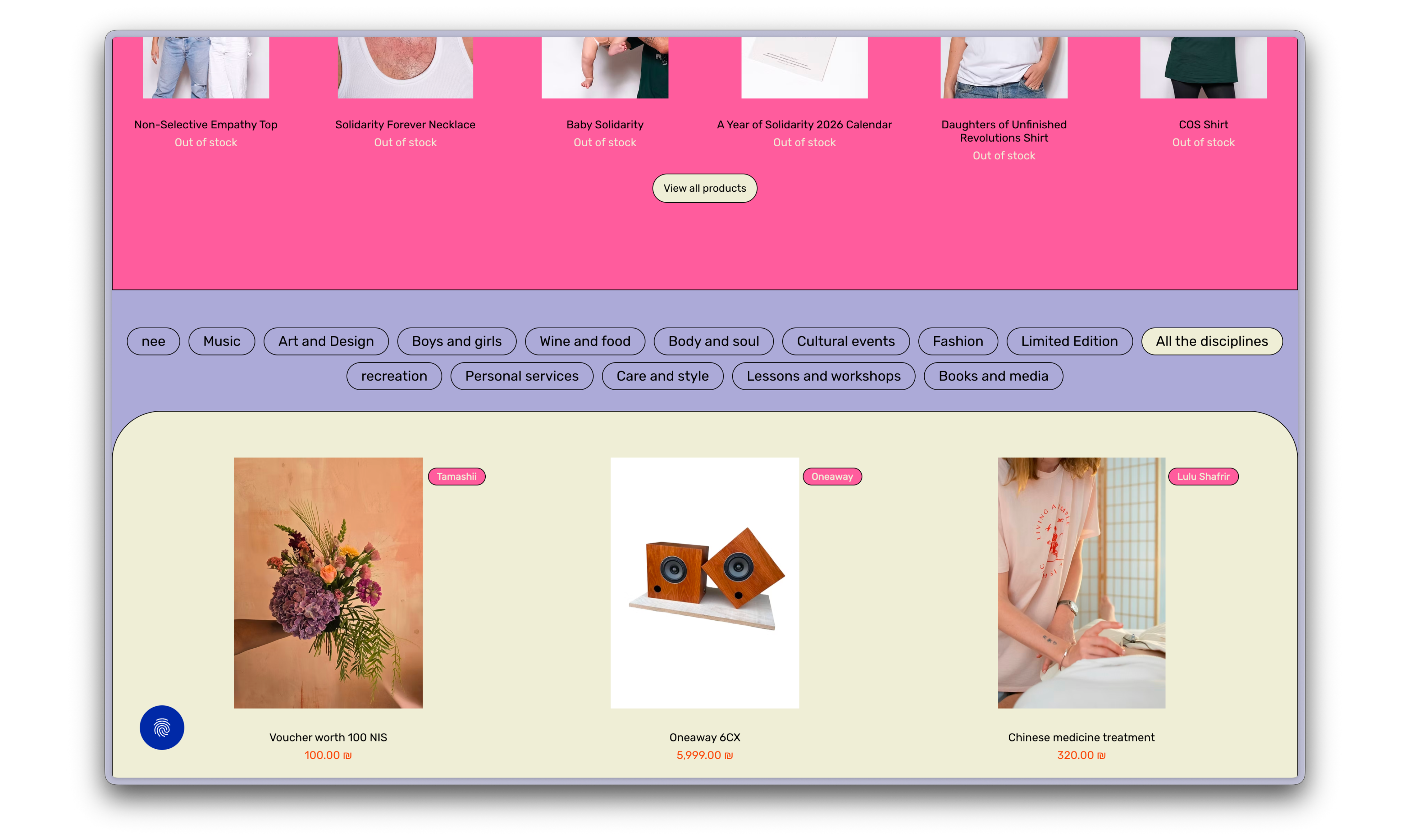
To address the rhetorical challenge, we focused on precise curation and design. We partnered with creators who shared our core values, guided by the principles of scale and range. Scale was essential to establish a sense of a large, unified camp, normalizing a humane discourse that had become marginalized. Range ensured inclusivity, allowing participation from as many donors and buyers as possible. We spanned disciplines, from fashion to literature, and price points, from a small embroidered keychain to a dinner for ten. We also mixed emerging artists with established brands.
Our design stepped away from the dichotomous, aggressive aesthetics typical of political campaigns. Framed around the December holidays, the visual language emphasized warmth, generosity, and shared humanity. Marketing leveraged this aesthetic to highlight the sheer volume of participation. By listing all donor names and showcasing rapid product sequences, we used popular retail formats to build consensus around ideas that were otherwise treated as taboo. We also supplied donors and high-profile creators with design kits to flood social media networks with a unified message.
INFRASTRUCTURE & AUTOMATION
To solve the logistical challenge, the backend required rigorous architecture. After a heavy-handed manual process the previous year and a deepened lack of resources, I aimed to scale the operation while making production comfortable for all stakeholders. With a team of developers, we built an automated infrastructure connecting our Wix storefront to an Airtable database via Make.com, with mailing handled through AWS. We engineered a dynamic routing system. Upon checkout, tailored alerts were instantly dispatched to specific donors, while buyers received customized fulfillment instructions. If a cart contained multiple diverse items, the system aggregated all realization steps into a single communication. This structure allowed us to execute a high-volume fundraiser with the precision of a scaled tech product.
collaborators
Omer Kishoni — Co-Lead
Apollo Crooks — Branding & Graphic Design
Frontend Development — Johanna Asseraf, Noam Ackerman
Backend & Integrations — Maor Kadosh, David Griver
Web Design — Johanna Asseraf, Maya Lynne Adar
context
Culture of Solidarity
I am an interdisciplinary artist, documentary filmmaker, and community organizer currently pursuing an MFA in the Design & Technology program at Parsons School of Design as a Fulbright fellow.
I craft stories and systems with and for humans in an era of humanization; asking how do we stay in ‘touch’ in a digital world?
MERCH FOR MUTUAL AID
medium
Online Store & Digital Fundraiser
role
Creative Director, Product Manager, Executive Producer
overview
Since its early days, I have been an organizer with Culture of Solidarity, a volunteer-based grassroots movement operating on shared community resources rather than institutional funding. This online holiday gift store is the organization's largest annual fundraising initiative, which I led throughout its evolution, and this year for its second edition during active war. It transforms collective resources into direct action, building consensus around the dignity of all lives while funding food security operations across Israel and Palestine.
THE PROJECT
I led the project from end to end, collaborating this year alongside Omer Kishoni and designated team leaders. We launched as a week-long pop-up store during the December holidays, culminating in a physical closing event. In a climate of dehumanization and escalating violence, our audience was largely Israeli and Jewish diaspora, a public saturated with trauma and survivalist political campaigns. Our goal was to offer accessible activism, raise funds, and normalize a humane consensus. To be as inclusive as possible across ages and economic realities, we offered 238 unique items donated by 142 creators and businesses from local communities to cities like New York. The inventory ranged from physical goods and digital services to memberships and one-off experiences: tattoos, haircuts, books, private classes, theater tickets, and bakery memberships. In total, we raised 104,500 ILS, which was sufficient to run our food security programs for four months. Achieving this required directing specialized teams across web development, donor recruitment, design, marketing, and logistics.
THE CHALLENGE
Fulfilling this mission presented a twofold challenge. The rhetorical challenge required operating like a high-level campaign to build partnerships and craft a meticulous, unifying aesthetic. The logistical challenge demanded an infrastructure capable of managing highly fragmented data. We needed a system that made donating and fulfillment effortless for everyone involved: the contributing businesses, the buyers, and the volunteer teams operating behind the scenes.
CURATION & DESIGN
To address the rhetorical challenge, we focused on precise curation and design. We partnered with creators who shared our core values, guided by the principles of scale and range. Scale was essential to establish a sense of a large, unified camp, normalizing a humane discourse that had become marginalized. Range ensured inclusivity, allowing participation from as many donors and buyers as possible. We spanned disciplines, from fashion to literature, and price points, from a small embroidered keychain to a dinner for ten. We also mixed emerging artists with established brands.
Our design stepped away from the dichotomous, aggressive aesthetics typical of political campaigns. Framed around the December holidays, the visual language emphasized warmth, generosity, and shared humanity. Marketing leveraged this aesthetic to highlight the sheer volume of participation. By listing all donor names and showcasing rapid product sequences, we used popular retail formats to build consensus around ideas that were otherwise treated as taboo. We also supplied donors and high-profile creators with design kits to flood social media networks with a unified message.
INFRASTRUCTURE & AUTOMATION
To solve the logistical challenge, the backend required rigorous architecture. After a heavy-handed manual process the previous year and a deepened lack of resources, I aimed to scale the operation while making production comfortable for all stakeholders. With a team of developers, we built an automated infrastructure connecting our Wix storefront to an Airtable database via Make.com, with mailing handled through AWS. We engineered a dynamic routing system. Upon checkout, tailored alerts were instantly dispatched to specific donors, while buyers received customized fulfillment instructions. If a cart contained multiple diverse items, the system aggregated all realization steps into a single communication. This structure allowed us to execute a high-volume fundraiser with the precision of a scaled tech product.
collaborators
Co-Lead — Omer Kishoni
Branding & Graphic Design — Apollo Crooks
Frontend Development — Johanna Asseraf, Noam Ackerman
Backend & Integrations — Maor Kadosh, David Griver
Web Design — Johanna Asseraf, Maya Lynne Adar
context
Culture of Solidarity
I am an interdisciplinary artist, documentary filmmaker, and community organizer currently pursuing an MFA in the Design & Technology program at Parsons School of Design as a Fulbright fellow.
I craft stories and systems with and for humans in an era of humanization; asking how do we stay in ‘touch’ in a digital world?